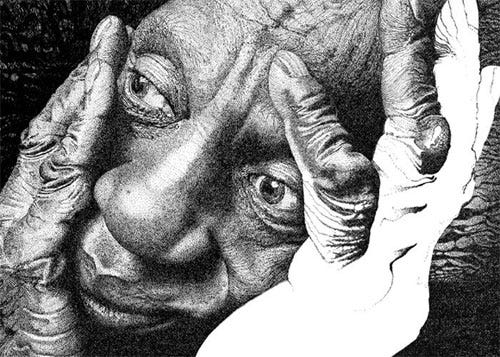
Phil Hansen is an artist. A pretty special one actually. And as well he ought to be. He spent almost his entire life pursuing this dream, honing his craft, eventually developing an incredibly unique style and skill known as pointillism: A method of creating images by using countless miniscule dots to produce a sort of pixelated effect.
It’s an incredibly difficult, patience-taxing and precise technique, but, one that can produce stunning results.
The problem was Phil got so good at it, so precise, that he developed a tremor in his hand. One that became so severe he was unable to continue the very special technique he’d developed over years and countless hours. Worse, the scarring along his nerves made his condition irreversible.
He would never again be able to do the one thing he’d built his whole life around.
In the video below (I highly recommend having a watch) Phil tells his story, of how he was forced to let go of what he’d spent a lifetime working towards.
He left art school, walked away from what he loved, was in a pretty dark place, before eventually — three years later — returning to his passion and deciding to embrace the new limitations his condition foisted on him.
He used his tremor to look at his art, and his life, differently, reinventing himself and going on to create a number of innovative pieces he’d have never considered doing, or even been able to, if not for the tragic circumstances that forced him to let go of the skills he felt had made him.
His tremor actually became an aid. In his words;
‘What I thought would be the ultimate limitation in fact became the ultimate liberation.’
Phil’s story got me thinking.
We all have plans; goals and dreams that we set out for. A way we hope and expect for things to be.
Is it possible these dreams can become barriers, walls that prevent us from viewing the full horizon and embracing all of what’s possible?
Can the dreams and goals we set ourselves stop us from seeing better alternatives?
Can a dream being broken, actually, sometimes, be a good thing?
From brokenness to breakthrough
It’s 2019. I’m sitting in a small wood panelled auditorium at The Albany, a pioneering community theatre in South East London. And an audience has just been stunned silent by what I’ve shared…
I’d been invited to speak at the Bare Lit festival — an arts and literature event featuring poets, novelists, journalists, documentary-makers etc. in conversation with one another.
Part way through the Q&A following my panel an audience member asked that I share the inspiration behind my debut novel, Lost Gods. And for some reason, I park my usual instinct to offer the safe response, and instead tell her the truth…
In conversation with author Tasha Suri at the 2019 Bare Lit Festival
That it all started through a question posed during an email exchange with a friend, asking that I describe the intense depression I’d been experiencing for several years up to that point.
Depression had derailed my degree, destroyed my plans of attending medical school, and left me stuck in a limbo of dead end office jobs with zero qualifications and fewer prospects.
It had torn apart my dreams, was continuing to torment my mind, and now I was being asked to somehow describe it.
“Don’t try to tell me how it feels,” the friend explained, “that may be too big for me to grasp. Just tell me, if it were some kind of entity, or creature, what would this depression you’ve known all this time be like?”
Despite the weirdness of the question, I answered, writing a paragraph to describe the requested imaginary creature. But what surprised me was my friend’s response to what I wrote, because suddenly depression was no longer the focus…
“Wow, Micah, sorry to get off topic but you’re an amazing writer!”
Which I don’t think I’d ever heard before…
This, alongside the catharsis of getting my experience out onto the page, is what triggered me to make writing… well, a thing.
Because somehow now there it was, my depression; this elusive nebulous thing, there on the page for me to see, and perhaps even destroy.
But how could it be destroyed on the page if not by some character sharing it? And how could that character exist if not within some kind of context or world? And what must that world be like if it cannot be like this one?
And in this way, as that initial first paragraph from an email evolved into reams and then pages of writing, my first novel, Lost Gods, was born.
Now, you can imagine my fear in opening up to strangers about such a vulnerable part of my past. But thankfully, and surprisingly, the audience’s silence when I shared this didn’t last long.
In fact, to my surprise audience members began sharing their own mental health experiences, or the experiences of their loved ones; shifting the session from a literary discussion into something far deeper.
Afterwards, attendees approached to share how impactful they’d found hearing about my journey into writing, even more so than hearing about the novel I’d been invited to the event to talk about.
For them, the story behind my story — my journey — was far more powerful than anything else I could have shared.
Journey over destination
In the bible, we see that dreams and purposes don’t happen in spite of challenges, they often happen because of them.
A young man named Joseph dreams of having influence and being a leader. But he’s then betrayed by his brothers, sold into slavery, and trafficked to a foreign land.
As a slave in the home of an Egyptian official he learns how to manage a wealthy household.
After being falsely accused and thrown into a dungeon he learns how to manage his heart.
After interpreting and serving the dreams of others, he is appointed as ruler over Egypt — the most powerful nation of that time.
Every seeming setback, hardship and heartbreak positions and prepares him to step into the realisation of the God-given dream he’d received as an adolescent boy.
Without that journey, as awful as it must have been, Joseph’s dream could never have been realised. And we wouldn’t have his story to be inspired by.
The inconvenient truth
Often, we struggle to anticipate the path that leads to the fulfilment of our aspirations.
Every obstacle is an enemy, every pain a thing to rally against or survive. We think the delays are working against our dreams, not for them.
But what if, like Joseph’s story, these adversities are the essential experiences that make the dream possible?
What if the very things that appear to be destroying your hopes, are precisely what will allow them to be fulfilled?
Confusingly, I’ve found this to be true of my own journey. The depression I experienced was horrific, soul destroying. It denied my dreams of medicine, which eventually led to me working in social and mental health services, and then later, to start writing.
Through writing I published a novel. Through publishing a novel I became a professional writer. Through writing professionally, and mentoring in social health, I was able to learn to mentor and coach other writers, then academics, then leaders, and eventually use my writing to work in tech, where I went on to specialize in content, product and design.
Through all of the above and more I was equipped with the acumen, experiences and expertise to create Natality—an AI-powered app designed to coach individuals towards the fulfilment of their most meaningful dreams.
It was the annihilation of my dreams, and all the knock-on effects that followed, that propelled me into what I’m doing (and loving) now.
Like Hansen said:
‘What I thought would be the ultimate limitation in fact became the ultimate liberation.’
So, what might this mean for you?
Why faith journaling matters
Journeying towards a genuine faith-inspired dream is one of the most challenging and important things you will ever do.
Yet perhaps the most potently impactful tool for navigating this journey is often the most under-used — the practice of journaling.
It’s no wonder journaling was practiced so readily by many of the bible’s most notable figures — David journaled, as did Solomon, Jeremiah, Nehemiah, Habakkuk, and many more.
And it’s why I designed Natality to offer an interactive journaling environment and community for those aiming to live purposefully and pursue faith-inspired goals.
Because if there’s one thing my own journey has taught me, it’s that finding community and tools to make sense of your path is essential.
So, whether your dream is to raise special humans as a homemaker, create art or music that inspires, or build a business that impacts the world for good, your journey and your goals matter, but you can’t achieve them alone.
So don’t…
Dream big, but don’t do it solo…
Join the Natality community
Natality’s AI-powered journaling app offers personalized coaching in real-time to support your goals, growth, and faith.
Connect to a worldwide community of members living purposefully.





 Natality
Leave a reply to aliyaanemily82 Cancel reply