Finding the right journaling ideas can be tricky. And I’ll admit, when I first began journaling, the idea there’d be this many ways to practice so introspective an art seemed strange to me.
But… through having coached dozens of clients—ranging from high-performing entrepreneurs to embattled academics and creatives—I’ve since discovered a range of journaling ideas, and how transformative they can be for self-reflection, self-discovery and self-mastery.
So, keep reading for considered thoughts on the most effective journaling ideas currently out there, and how you can use them to:
Hone your thinking
Manage your emotions
Transform your relationships
And drill deep to harness your innermost drives in service of big goals.
Whether you’re a seasoned journaler or just starting out, this guide will give you everything you need to keep your practice fresh, impactful, and rewarding.
Sidenote: if you’d like to fast-forward past the science and ideas to the prompts themselves, you can do so by flicking open the toggle below…
“Think of expressive writing as a life course correction.”
Dr James Pennebaker, Professor Emeritus of Psychology, University of Texas
What are journaling prompts, and why do they matter?
A journaling prompt is simply a question or idea designed to spark expressive writing, and by that I mean the kind of writing that sneaks up from the deeper and more personalized parts of your thinking.
This matters.
Because when you’ve had one of those days—when your brain feels like it’s stuck in rush-hour traffic: too many thoughts, no clear direction—sitting down to journal can be tough.
A well-crafted journaling prompt grants you a clear starting point.
You begin to write (an act in and of itself that slows things down) and suddenly find yourself with enough mental breathing room to reflect, think, and sort through things.
Whether you’re dealing with big emotions, chasing a goal, or just trying to make sense of life’s chaos, journaling prompts are like a trusty GPS for your mind.
Not only do they rescue you from blank-page panic, they help you to uncover fresh insights, and can keep you moving forward (with your journaling and everything else) when you’re tempted to quit.
Try AI-powered journaling with Natality
Natality helps you uncover insights and stay on track with interactive AI guidance tailored to your personal growth.
Join the waitlist to try Natality for FREE, and see how it transforms the way you journal!
How effective are journaling prompts? Journaling benefits backed by science
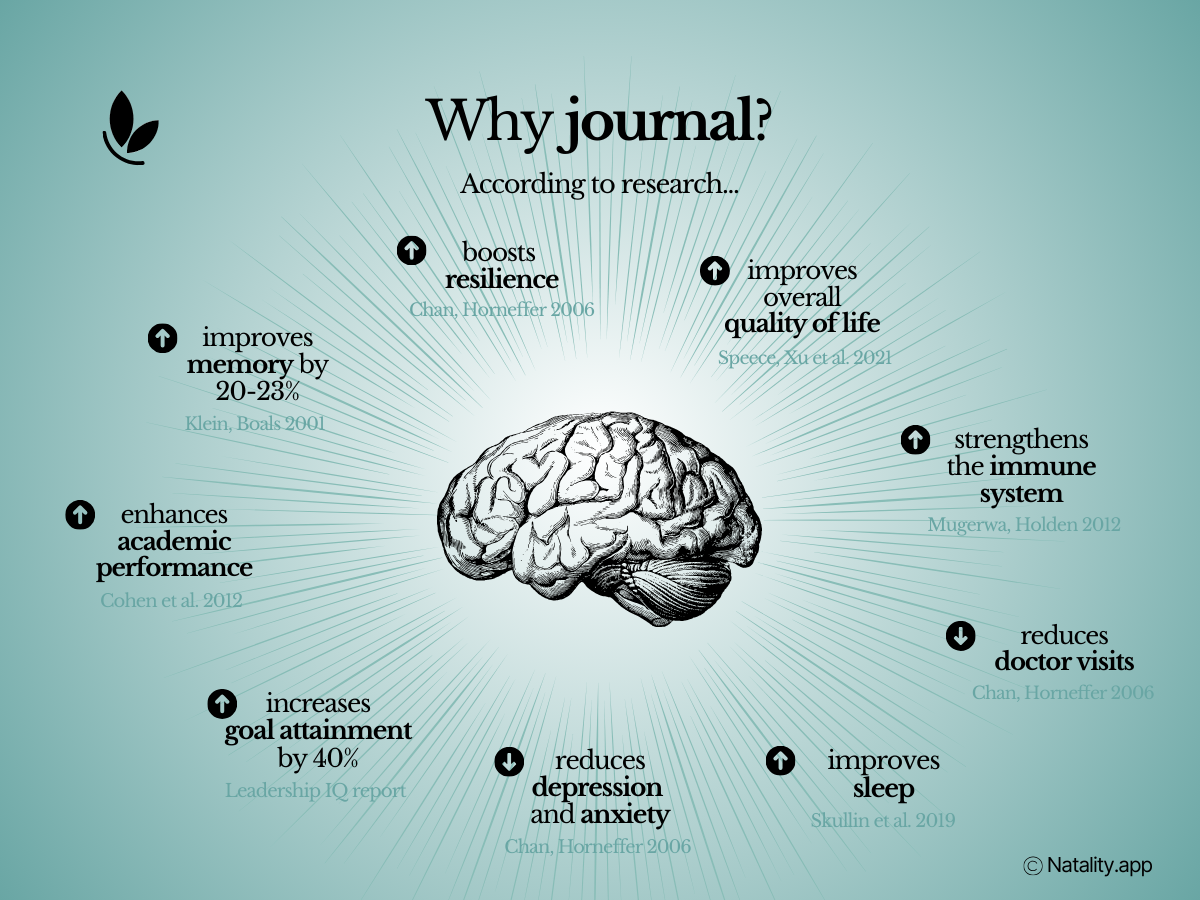
First things first: a good journaling prompt doesn’t just tame mental clutter; it helps you connect dots to upgrade your thinking and regulate your emotions more effectively.
In fact, studies show that using a journaling prompt:
Mounting research suggests journaling has comprehensive and transformative benefits
Not too shabby, but what’s especially impressive is how quickly these results can take effect.
In one study, people who practiced expressive writing using journaling prompts for just 15-20 minutes, three to five times, experienced noticeably better physical and mental health compared to those who stuck to writing about neutral topics.
Bottom line: you can use journaling prompts for less than a week and begin to experience the benefits.
As psychologist Dr James Pennebaker explains in his research:
“People who benefit from writing express more optimism, acknowledge negative events, are constructing a meaningful story of their experience, and have the ability to change perspectives as they write.”
Dr James Pennebaker, Professor Emeritus of Psychology, University of Texas
Why are journaling prompts so effective for managing emotions?
Using journaling prompts is like having a private therapist who’s available 24/7 (and free!).
And that isn’t an overstatement.
A big part of what makes them so effective for managing emotions is they tap into the power of self-distancing—a psychological phenomenon that allows you to step back and view your emotions or challenges from a third-person perspective, like an observer rather than a participant.
By using a prompt to put your feelings into words, you’re not just venting—you’re creating a sense of emotional distance that helps you process those feelings more clearly and objectively.
This reduces stress, helps you feel more in control, and builds the kind of mental clarity that allows you to more easily organize your thoughts, often boosting your mood for good measure.
Are journaling prompts only for managing stress or mental health challenges?
Using journaling prompts isn’t exclusive to heavy, soul-searching moments. In fact, alongside limiting stress, they’ve been shown to:
“Something as simple as writing about the problem for 20 minutes can yield important effects not only in terms of physical health and mental health, but also in terms of cognitive abilities.”
Dr Adriel Boals, Psychology researcher at the University of North Texas
Journaling, at its heart, is an impressively flexible tool.
Whether you’re figuring out your next big career move or just tracking how much you adore your dog, there’s a journaling idea and style for everyone.
Here are some prompts you can cozy up with to help process your experiences when you need to.
Journaling prompts for mental health and emotional wellbeing
Write a letter to someone (you don’t have to send it) expressing feelings you’ve been holding back.
Write about a time you felt truly at peace. What contributed to that feeling?
Describe a recent challenging experience and the feelings it evoked. List each individual emotion. Which specific element of the experience is each feeling attached to?
Recall a situation where you overcame a difficult emotion. List 3 things the experience of overcoming it taught you about yourself?
Reflect on a time you forgave someone. How did it impact your emotional wellbeing?
Reflect on an emotion you’ve been experiencing frequently. Describe where you were and what you were doing when you last felt it.
Identify a recurring negative thought you’ve been experiencing recently. Describe what you’d say to a close friend if they were experiencing this thought.
Journaling ideas to focus your thoughts and emotions
Describe a time when you felt completely “in the zone.” What were you doing, and what emotions came with it?
Write down three thoughts currently on your mind—no filter, just let it flow.
Think about a time when someone helped you gain perspective on an issue. What did they say or do? And how did this change your outlook?
Write about a decision you’re wrestling with. List the pros and cons for each option.
List five things that have been weighing on your mind lately and rank them by priority.
Journaling prompts for anxiety and finding calm
Write about one small thing you can control today, no matter how minor it feels.
Describe a moment from the last month when you felt most relaxed. What can you incorporate from that moment into your daily routine?
Describe a place where you feel completely safe and calm. What makes it so comforting?
List three things that are going right in your life right now, however small.
List five things you are grateful for today. Reflect on why they matter to you, and how they make you feel.
Write down a worry you’ve been carrying. Imagine the best-case scenario, then describe it in as much detail as you can.
Imagine your anxiety as a character or shape. What would it look like, and what would you say to it?
Think of a recent situation that made you anxious. What advice would you give a friend in the same situation?
Try AI-powered journaling with Natality
Natality helps you uncover insights and stay on track with interactive AI guidance tailored to your personal growth.
Join the waitlist to try Natality for FREE, and see how it transforms the way you journal!



 Natality
Leave a comment